
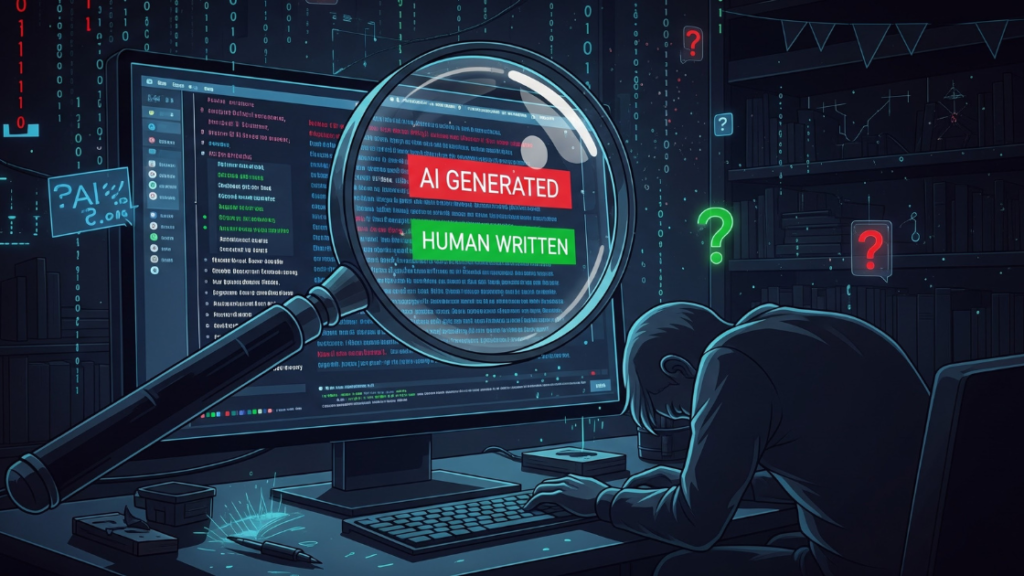
Most people have no idea how AI content detectors actually work. They just assume the tool is right, until it wrongly flags their human-written blog, essay, or campaign copy.
This article breaks down the truth behind AI detectors: how they operate, why they misfire, and what it means for marketers, writers, and businesses using AI tools.
Key Takeaways
- AI content detectors look for statistical patterns like predictability and sentence variation, not meaning or intent.
- False positives are common; human-written text is often mislabeled as AI, especially if it’s concise or simple.
- False negatives happen, too, with polished AI writing slipping past detectors undetected.
- Different tools (GPTZero, Originality.ai, Turnitin) use different methods, but none are fully reliable.
- Google doesn’t ban AI writing but rewards content that shows expertise, depth, and originality.
- Writers, marketers, and agencies are adapting through hybrid workflows, stronger editing, and proof of authorship.
- Detectors lack legal and ethical standards, raising questions about fairness and accountability.
- The long-term solution is creating valuable, human-centered content that audiences trust.
What Are AI Content Detectors?
Before we break down how they function, it’s important to understand what these tools actually are, who uses them, and why they’ve become so controversial. AI content detectors aren’t a single kind of technology; they’re a category of tools built on various techniques to identify whether text was machine-generated. But they’re far from perfect.
The rise of detection tools
The popularity of ChatGPT and other large language models triggered a parallel boom in AI detection tools. Almost overnight, everyone from teachers to SEO professionals began relying on them.
- In academia, tools like GPTZero were adopted to detect AI-written essays and exam answers.
- Content agencies began screening freelancers’ submissions to check if they’d been written entirely by bots.
- Tech companies quietly built internal detection systems to filter out AI spam in customer reviews, support tickets, and product descriptions.
As AI-generated content flooded digital spaces, detection tools were marketed as the safeguard for truth, quality, and originality. That promise, however, has come under fire.
Their purpose vs. their reality
In theory, AI detectors are supposed to promote integrity. They aim to separate human writing from machine-generated output so audiences can trust what they read.
In practice, it’s more complicated:
- Human-written content is often flagged as AI, especially if it’s too polished or too simple.
- AI-written content can slip through undetected, especially if prompts are tweaked to “sound more human.”
- There’s no standard for accuracy. Each tool reports its own performance, often with limited transparency.
The gap between what they claim to do and what they actually deliver is growing, and it’s affecting writers, marketers, students, and even journalists.
Read more: Is AI Generated Content Good for SEO?
The different user groups turning to AI detection
AI content detection tools aren’t only used in classrooms. Adoption has spread across multiple industries, each with their own stakes and risks:
- Educators and institutions: Often the first to use detection tools, especially for assignments, applications, and exams.
- SEO professionals and content teams: Use detectors to make sure AI-assisted blogs won’t hurt rankings or raise red flags.
- Editors and publishers: Screen submissions to catch full or partial AI use that may compromise originality or tone.
- Corporate comms and HR teams: Flag resumes, internal documents, or press releases that may be AI-penned without disclosure.
Each of these groups uses the same category of tools for very different goals, and the lack of standardization is causing friction across the board.
How AI Content Detectors Actually Work
Most AI detectors operate on a handful of core techniques that try to spot patterns in writing that suggest it came from a machine. But these tools don’t “read” the way a human does. They don’t check for ideas, nuance, or intent. They look for mathematical signals, statistical fingerprints of artificial generation.
Each method has its strengths. Each has its limits.
Token pattern analysis and predictability scores
Language models like GPT break writing down into “tokens,” or chunks of words and characters. These tokens follow statistical patterns when generated by AI.
Detection tools use two key metrics:
- Perplexity: Measures how surprising a word is in context. Human writing tends to have higher perplexity, with more variation and unexpected word choices.
- Burstiness: Looks at sentence variation. Human writing usually mixes short and long sentences. AI tends to be more uniform, especially with default settings.
If your content is too smooth, too predictable, or too even in sentence structure, it may be flagged, even if you wrote it yourself.
Watermarking and why it hasn’t caught on
Watermarking was once considered a promising solution. The idea was to have AI models embed invisible patterns into their outputs, like a signature.
Why it failed to take hold:
- OpenAI explored it but ultimately dropped the plan, citing poor reliability.
- It doesn’t work on paraphrased or partially edited content.
- It requires agreement across all model makers, which is unlikely in a competitive industry.
So while watermarking sounds neat on paper, in reality, it’s impractical. That’s why detection tools still rely on surface-level writing traits.
Training data comparisons and known-model matching
Some detectors try to identify content by comparing it to known outputs from AI models trained on public datasets.
Here’s how it usually works:
- The tool uses a database of common AI outputs and runs comparisons.
- If your content looks too similar, it may get flagged, even if you didn’t copy or prompt from those sources.
- Fine-tuned or locally trained models can escape this detection method entirely.
In short, this method is narrow in scope. It works best when someone is copying or lightly editing known AI responses, but struggles with more complex or original outputs.
Neural fingerprinting and advanced detection research
A newer approach gaining interest is neural fingerprinting. Instead of looking at surface patterns, this method tries to detect how content was generated at a deeper structural level.
It’s still experimental, but here’s what it aims to do:
- Identify stylistic “imprints” unique to machine-generated text, beyond just word choice.
- Work even when the text has been reworded or edited.
- Track outputs back to specific model architectures.
Right now, it’s mainly in the research phase. No mainstream tools use this reliably at scale yet. But in time, this may become the next generation of detection, assuming it can overcome false positives.
Commonly Used AI Detectors and How They Differ
Not all AI content detectors play by the same rules. Some were built for academic use, others for SEO teams or publishers. Their methods vary, their accuracy fluctuates, and their track records are far from spotless.
Here’s a breakdown of the most talked-about detectors, and what sets them apart.
Gptzero became the go-to tool for educators
GPTZero shot to fame on social media as the solution for catching students using ChatGPT for homework and essays. It promises to distinguish human-written work from AI by analyzing perplexity and burstiness.
What you should know:
- It’s designed with educators in mind. Simple interface, no cost for basic use.
- Often produces confident results, but confidence doesn’t equal accuracy.
- Has flagged poetry, legal documents, and ESL writing as “AI-generated” even when written by real humans.
It may work best as a quick check, but relying on it for disciplinary action without verification is risky.
Originality.ai targets SEO professionals and publishers
Originality.ai was built with content marketers and agencies in mind. It combines AI detection with plagiarism checking in one tool.
Key differences:
- Paid-only platform, often used by SEO agencies to audit writers.
- Offers team collaboration features and scan history.
- Known for being strict, sometimes too strict, especially with content that’s edited for clarity or brevity.
Originality.ai tends to flag anything that “looks too clean.” If you write efficiently and don’t ramble, it might think you’re a robot.
Turnitin AI detection got embedded in academia
Turnitin added AI detection to its legacy plagiarism platform, integrating it into schools and universities around the world.
What makes it unique:
- Students can’t opt out, it’s part of the grading process now in many institutions.
- Flags AI writing in percentage form (e.g., “82% AI-written”).
- Pushback has been significant. Several universities have rolled back usage after students were falsely accused.
The lack of transparency in how Turnitin’s AI detector works has created tension. It’s a black box with real-world consequences.
Openai’s classifier failed to deliver and was shut down
OpenAI, the maker of ChatGPT, released its own AI detector in early 2023. Then they quietly took it offline just months later.
Why?
- Accuracy was poor. Too many false positives and negatives.
- Users reported inconsistent results even on obvious AI content.
- OpenAI acknowledged it wasn’t reliable enough to be useful.
This revealed a deeper issue: even the companies building the models struggle to detect their own outputs.
Why AI Content Detectors Get It Wrong (A Lot)
For all their confidence, AI content detectors are deeply flawed. Their results often swing between false alarms and complete misses, leaving real people caught in the middle. The problem isn’t only technical but also human, legal, and even cultural.
False positives are alarmingly common
One of the biggest criticisms of AI detectors is how often they flag genuine human writing as “AI-generated.”
- Students have been accused of cheating because their essays “scored too robotic.”
- Journalists have seen their original reporting flagged by detection tools.
- Non-native English speakers, whose writing may follow simpler patterns, are disproportionately targeted.
The irony is that clarity and conciseness, traits many writers work hard to achieve, are often the very things that get mislabeled as AI.
False negatives let polished AI writing slip through
On the other side of the spectrum, detectors frequently fail to catch advanced AI text. With models like GPT-4, Claude, and Gemini producing content that reads fluidly, the line between human and machine blurs.
Small tricks can help bypass detection, such as:
- Adjusting generation settings to increase variation.
- Asking the AI to “write like a human” or mimic a specific style.
- Lightly editing or paraphrasing AI output.
The result? Plenty of machine-written content gets a free pass, while innocent human work gets caught.
Biases baked into the system
AI detectors are trained on limited data, which introduces bias into their results. This shows up most clearly in two ways:
- Language bias: Essays written in simpler English are flagged more often, penalizing non-native speakers.
- Stylistic bias: Certain tones, technical writing, academic essays, even poetry, tend to be marked as “too AI-like.”
This uneven treatment isn’t a small glitch. It affects who gets punished and who gets overlooked.
Accuracy claims are unreliable
Most detection companies boast accuracy percentages on their websites. But those numbers are self-reported and rarely peer-reviewed. No independent standard exists to measure whether one detector is truly better than another.
That means users are left in the dark, making decisions based on tools that may or may not be right. And when livelihoods, grades, or search rankings are on the line, that uncertainty is dangerous.
Can You Trick or Bypass AI Detectors?
Once people realized AI detectors weren’t bulletproof, the next question was obvious: can they be tricked? The short answer is yes. There are countless strategies, though most come with trade-offs in quality, ethics, or both. Here’s a closer look at the most common methods.
Human rewriting and paraphrasing tools
One of the easiest ways to slip past detectors is to rewrite AI-generated text manually or with a paraphrasing tool.
- Manual rewriting: A human editor tweaks sentence structure, adds variation, and changes word choice. This often makes the text feel more authentic but adds time and cost.
- Paraphrasing tools: Platforms like Quillbot or Spinbot rephrase AI content automatically. While faster, they can strip nuance and leave the text awkward or unnatural.
The downside? These approaches can save face in the short term but risk damaging the readability and credibility of the content.
Prompt engineering techniques
Detectors typically flag writing that looks too predictable. Adjusting how the AI is prompted can make a difference.
- Asking the model to write with more “burstiness” (mixing sentence lengths and structures).
- Setting higher randomness (temperature) so word choices feel less formulaic.
- Giving the AI specific stylistic instructions, such as imitating a known author or using colloquial language.
While this can help outputs pass as human, it doesn’t eliminate the underlying issue, detectors may still catch parts of the content, and the results vary widely.
AI-to-human rewriters
A newer category of tools has emerged that claim to “humanize” AI text so it passes detection. They usually run the content through another AI trained to disguise telltale patterns.
Problems with this approach:
- The content often becomes bloated or overly wordy.
- Meaning can get distorted, making the final draft less accurate.
- It turns into a cat-and-mouse game, with detectors constantly updating to catch these rewriters.
These tools may work today but fail tomorrow as the technology on both sides evolves.
The arms race problem
Every bypass method eventually pushes detectors to adapt. As soon as people find a reliable trick, new detection updates roll out to counter it. The result is an endless back-and-forth where neither side fully wins.
For businesses, students, and writers, this creates constant uncertainty. Instead of focusing on quality and originality, they’re stuck worrying about whether a tool will flag their work.
Are AI Detectors Legally or Ethically Reliable?
The idea of using AI to police AI writing seems logical, but the practice raises serious concerns. Accuracy aside, the legal and ethical implications of these tools are still unsettled, leaving students, professionals, and businesses exposed to unfair treatment.
No standardized accuracy benchmark exists
AI detectors are not held to a single global standard. Each company reports its own “accuracy rates,” often based on small internal tests.
- A tool may claim 95% accuracy, but that number could mean little without context, was it tested on essays, blogs, or short prompts?
- Some tools perform better on English text but stumble on other languages.
- There’s no peer-reviewed body verifying claims, which leaves users relying on marketing promises.
This lack of oversight means organizations may enforce rules with unreliable evidence.
Ethical implications of misuse
False accusations carry weight. In schools, students have been penalized or even failed based on detector results that were later proven wrong. In workplaces, writers and freelancers have lost credibility, or clients, because a tool misclassified their content.
At the heart of the issue is accountability. Unlike plagiarism detection, which checks against actual sources, AI detection is probabilistic. It says, this looks like AI. That’s not hard proof, yet institutions treat it as such.
Transparency issues with black-box systems
Most detectors are proprietary. Users see the results but not the reasoning. That creates several problems:
- You can’t audit how the decision was made.
- There’s no appeal process if the result is wrong.
- Biases in the model remain hidden from public scrutiny.
This opacity undermines trust. Without clear explanations, people are forced to accept results on faith, even when their careers or education are at stake.
Growing legal questions
As more cases emerge where people are penalized on faulty detection, legal challenges are likely. Key questions include:
- Can a school or employer justify punishment based on a tool with no verified accuracy?
- Do false positives open companies or institutions to liability?
- Should there be regulation for how detectors can be used, especially in high-stakes environments?
For now, the law lags behind the technology. But the pressure is mounting for some form of oversight.
How Marketers, SEOs, and Writers Are Responding
As AI content detectors spread, creative professionals and businesses are adjusting. Some are changing how they write, others are rethinking workflows entirely. What unites them is a shared challenge: protecting credibility in a landscape where detectors can’t always be trusted.
SEO teams are rewriting content for “human-ness”
Search-focused teams know that detectors can sometimes trigger manual reviews or raise doubts about originality. To minimize risk, they’re adapting content to feel less “machine-polished.”
- Writers introduce more variation in sentence length.
- Editors add anecdotes, examples, or small imperfections to mimic human cadence.
- Drafts are screened against multiple detectors before publishing.
This process adds time and cost, but many see it as necessary insurance for rankings and reputation.
Agencies are rethinking outsourcing models
Marketing and publishing agencies once leaned heavily on outsourced writers or pure AI workflows. Now, the uncertainty of detection results has forced a shift.
- Hybrid teams combine AI tools for drafting with human editors for revision.
- Agencies invest in training writers to use AI responsibly rather than replacing them.
- Internal QA processes are stricter, with dedicated staff reviewing style, originality, and authorship evidence.
The old model of “fast and cheap” AI-driven production is giving way to more balanced, quality-focused approaches.
Writers are documenting proof of authorship
Freelancers, journalists, and students are increasingly keeping receipts to defend themselves against false accusations.
- Drafts are timestamped in Google Docs or Notion.
- Revision histories show the natural evolution of an article or essay.
- Screenshots or saved notes prove the human process behind the text.
For many, this has become a safety net. If a detector flags their work incorrectly, they have a paper trail to prove it’s original.
Businesses are prioritizing audience trust over detector results
Not everyone is playing the detector game. Some brands focus less on whether AI is spotted and more on whether their audience finds value. They aim for content that resonates, regardless of how it was created.
This doesn’t mean ignoring authenticity. Instead, it’s about shifting the goalpost: success is measured by engagement and conversions, not whether a detection score reads “100% human.”
Do Search Engines Like Google Use AI Detectors?
One of the biggest fears in marketing is that Google secretly uses AI detectors to penalize websites. The reality is more nuanced. While Google has spoken on the issue, the company’s actions and ranking behaviors tell a more complicated story.
What Google has officially said
Google has stated clearly that it doesn’t care if content is written by a human or generated with AI. What matters is quality. Their guidelines highlight E-E-A-T: Experience, Expertise, Authoritativeness, and Trustworthiness.
That means an article with depth, accuracy, and clear value to readers will be treated well, regardless of how it was produced. A shallow, keyword-stuffed piece will struggle, AI-written or not.
Unofficial patterns in ranking behavior
Marketers, however, have noticed trends that suggest the picture isn’t so simple.
- Sites publishing high volumes of generic AI content often see traffic dip over time.
- Human-edited AI content that integrates real examples, case studies, or unique insights performs better.
- Some industries, finance, health, legal, are especially sensitive. In these niches, Google appears tougher on content that feels formulaic or machine-like.
So while Google may not be running AI detectors in the background, its algorithms still reward human qualities that detectors often look for: variety, depth, and originality.
The indirect effect on SEO strategy
Even if Google isn’t directly scanning for AI, marketers behave as if it might be. The fear of being penalized has led to:
- Extra editing layers before content goes live.
- More investment in original research, interviews, and expert contributions.
- A push toward hybrid workflows where AI handles drafting but humans add the finishing touches.
The effect is indirect but real: detection tools may not be embedded in search algorithms, but they shape how SEO professionals create content.
How Trelexa Helps You Stay Authentic and Compliant
At Trelexa, we understand the pressure businesses face when balancing efficiency with originality. Our approach is simple: we help you create content strategies that combine human creativity with AI support without triggering red flags. That means every piece you publish is not only polished but also trusted by audiences and platforms alike. We focus on workflows that keep your brand credible, authentic, and competitive in a noisy digital space.
Final Thoughts
AI content detectors and AI writing tools are locked in constant competition. As large language models become more advanced, detectors scramble to keep up. When detectors improve, users discover new ways to bypass them. The result is an arms race with no clear winner.
For writers, marketers, and businesses, this back-and-forth can feel exhausting. You may spend more time second-guessing how your work will be judged than focusing on the actual value it provides. And yet, that’s the most important factor of all, value.
Detectors may rise and fall, but audiences and platforms still reward content that informs, persuades, and resonates. If your writing feels alive, if it offers clarity, and if it reflects real thought, it will outlast every tool designed to second-guess it.
The future of content isn’t about beating AI detectors. It’s about creating work that stands on its own, regardless of who, or what, helped draft it.