

A quiet book launch online can feel like shouting into a void. You pour your heart into the writing, hit publish, post a celebratory caption—and nothing happens.
This guide breaks down how to use social media to actually move books and build real reader connections. No fluff, no gimmicks—just practical steps that work.
Key Takeaways
- You don’t need every platform—just the right one. Focus on where your readers already spend time, and show up there consistently.
- Your author brand is more than a logo. It’s how you speak, what you share, and how you make readers feel across every post.
- Content works when it builds connection. Behind-the-scenes moments, personal stories, and small details often sell books better than direct promos.
- Video increases visibility—even if it’s simple. Short clips, voiceovers, or screen-recorded reads can boost your reach without needing polish.
- Involve your audience early. Treat followers like insiders with sneak peeks, polls, and invitations to join your launch journey.
- Stay consistent without burning out. A light but steady rhythm (like 3 posts per week) supported by batching and tools can keep you visible and sane.
- Common pitfalls are easy to fix. Avoid silent stretches, empty promo links, and vague posts—give context, reply to comments, and guide your readers clearly.
- Trust is what turns followers into buyers. Repeat exposure, soft CTAs, and authentic interaction matter more than flashy campaigns.
- Real authors succeed by being real. Case studies show that passion, personality, and platform-specific content move the needle more than any “hack.”
Why Social Media Still Matters for Authors Today
Social media may not be the newest tool on the shelf, but it remains one of the most effective ways to connect with readers—when used with intention. It’s not about chasing likes or follower counts. It’s about building a space where your voice, values, and book can be discovered by the right audience.
Below, we break down why social media still earns a place in every author’s strategy.
Readers connect with authors, not just books
Readers don’t just want stories—they want storytellers they can relate to. Social media gives you a place to show the person behind the pen. That kind of visibility builds trust, which in turn builds loyalty.
You don’t need to overshare or pretend to be someone else. You just need to show up consistently in a way that feels real. A short post about a scene that made you cry or a behind-the-scenes look at your writing routine is often more effective than shouting “Buy my book!”
Visibility has replaced gatekeeping
Traditional book publicity relied on gatekeepers—publishers, media outlets, bookstores. Today, you can build your own spotlight. Platforms like TikTok and Instagram have shown that even debut authors can go viral when their content resonates.
This doesn’t mean “hope to go viral.” It means understanding that the playing field is more open than ever, and authors who learn how to use it wisely have a serious edge.
Community drives long-term success
Your book might hook a reader. But your presence keeps them around for the next one.
That’s the power of community—your social media audience becomes your early reviewers, event attendees, launch team, and word-of-mouth marketers. And you don’t need thousands. A few hundred engaged followers are often enough to fuel steady sales and support.
Key ways community shows up:
- Reposting and reviewing your work
- Showing up to live events or Q&As
- Supporting your next project before it’s even announced
Social media isn’t a sales pitch—it’s a conversation
People are tuned out to constant promotions. But they’re always listening for stories that feel honest or meaningful. When you treat your posts like part of an ongoing conversation instead of a sales ad, readers stay curious.
Respond to comments. Share your process. Ask questions. That kind of presence is harder to measure than click-through rates—but it’s what actually builds relationships.
Pick Your Platform Like a Publisher, Not a Tourist
You don’t need to be everywhere. You just need to be where your readers are—and show up with purpose. Too many authors treat social media like a sightseeing tour, hopping from one platform to another without a clear direction. Publishers don’t do that. They study where the audience lives and how to speak their language. You should too.
Know where your readers actually are
Every genre attracts a different crowd, and those crowds gather in different corners of the internet. Understanding where your ideal readers hang out helps you focus your energy instead of spreading yourself thin.
Here’s a quick snapshot:
- Romance, fantasy, YA: TikTok (BookTok) and Instagram are key. Aesthetic content, fan-driven trends, and quick emotional storytelling thrive here.
- Memoir, nonfiction, lifestyle: Facebook groups and long-form Instagram captions create space for emotional connection and discussion.
- Business, self-help, leadership: LinkedIn and X (formerly Twitter) offer authority-building through thought pieces, behind-the-scenes content, and professional storytelling.
- Poetry, literary fiction: Instagram (especially Stories and Reels) allows for short, reflective pieces paired with imagery.
Don’t guess—spend time observing. Follow hashtags, browse author profiles in your genre, and see where conversations are already happening.
Prioritize depth, not volume
Posting twice a week on one platform with clear purpose beats trying to “stay active” on five. Consistency matters more than frequency—and quality wins every time.
Start by asking:
- What platform do you actually enjoy using?
- Where are you more likely to engage, not just broadcast?
- Which format fits your comfort level—text, video, images, or audio?
Once you’ve picked your platform, give it a real chance. Test content types. Experiment with timing. See what sparks interaction—not just impressions.
You’re not just building reach. You’re building rhythm.
Understand what each platform is best at
Every social media platform plays a different role. Understanding their unique strengths helps you create the kind of content that belongs there—not forced cross-posts.
Here’s a platform breakdown worth bookmarking:
Great for: Visual storytelling, cover reveals, Reels, carousel quotes
Best used for: Aesthetic branding, behind-the-scenes content, community polls
TikTok
Great for: Raw, short-form videos that show emotion or tell a story
Best used for: Character skits, reader reactions, book flips, and trending audio moments
Great for: Thought leadership and long-form commentary
Best used for: Nonfiction authors, B2B books, personal transformation stories
Great for: Niche groups, older reader demographics, long-form posts
Best used for: Personal storytelling, community building, event invites
X (Twitter)
Great for: Quick wit, industry news, real-time discussion
Best used for: Building an author voice, participating in writer chats, linking to longform content
YouTube
Great for: Longer videos, deep dives, vlogs, reading excerpts
Best used for: Author interviews, live readings, book trailers
You don’t have to pick forever. You just have to pick one to take seriously right now.
Your Author Brand Needs a Voice, Not Just a Logo
Your book may bring readers in, but your voice is what keeps them around. A strong author brand isn’t about having a slick logo or a catchy tagline. It’s about showing up in a way that feels unmistakably you—across your posts, comments, videos, captions, and visuals.
Know what you stand for beyond the book
Readers don’t just follow authors because they write good stories. They follow them because they resonate with why they write them.
Take a step back and ask yourself:
- What themes keep showing up in your work—hope, rebellion, resilience, healing?
- What part of your personal journey shapes the way you tell stories?
- What do you want readers to feel after interacting with you online?
Once you name that core, you’ll stop wondering what to post. You’ll know what your message sounds like—even on a bad day.
This becomes the foundation of your tone, your captions, your bio, and your interaction style. Quiet or bold. Funny or poetic. Direct or exploratory. All are valid—as long as they’re real.
Use visuals that feel consistent, even if they’re simple
You don’t need a brand kit. You need a visual mood.
That means picking a general vibe and sticking to it—colors, filters, font style, layout. When your feed looks and feels coherent, people start to recognize your posts before they even see your name.
Free tools to make it easier:
- Canva: Easy templates for quotes, announcements, and reels covers
- BookBrush: Specifically made for authors (cover mockups, 3D books)
- Coolors: Helps you pick brand colors that work together
Think of your visuals like the packaging of your book. It should reflect the tone inside—no more, no less.
Let your tone guide your captions, comments, and replies
Your tone isn’t a performance. It’s a habit. It shows up not just in what you post, but how you talk to your readers—especially when nobody’s watching.
If your book is lyrical and introspective, lean into thoughtful captions. If it’s sharp and witty, don’t be afraid to drop one-liners or punchy replies. If your writing blends emotion with intellect, let your comments reflect that mix.
The goal isn’t to craft a persona. It’s to reflect the best version of your real voice, consistently. That’s what makes readers feel like they know you—even before they’ve turned a single page.
Content That Sells Without Being Salesy
People don’t log onto social media to be pitched. They scroll to feel something, learn something, or connect with someone. That’s why authors who only post “buy my book” links see little traction, while others sell out pre-orders by simply telling honest, engaging stories.
Share the moments behind the scenes
Readers want to be part of the process, not just the outcome. You don’t need a content team or fancy equipment—just a willingness to share what’s really happening behind the pages.
Examples of behind-the-scenes content:
- A line you rewrote five times before it clicked
- A picture of your writing space during edits
- The playlist you listened to while writing your protagonist’s turning point
- Notes from your editor that made you rethink a character arc
These moments build emotional buy-in. They make people feel like they’re walking alongside you, not just watching from a distance.
Mix evergreen posts with timely ones
Not everything has to be launch-related. Some of your best-performing posts will be the ones that speak to themes or emotions that always matter to your audience.
Evergreen content ideas:
- Favorite quotes from your own book
- Writing tips or lessons learned
- Reader testimonials
- Reflections on your writing journey
Timely content ideas:
- Countdown to launch day
- Cover reveal or unboxing
- Live Q&A session the week of your release
- A post thanking early reviewers
Mixing both keeps your feed dynamic. Evergreen content builds consistency. Timely content creates urgency.
Use the 5 E’s to guide your content mix
If you’re ever stuck on what to post, use this rule of thumb. Your feed should rotate between these five content types to stay interesting and balanced:
- Educate: Share insight into your genre, writing craft, or publishing lessons.
- Entertain: Use humor, relatable author moments, or short creative videos.
- Engage: Ask your audience questions, post polls, run caption contests.
- Empower: Share encouraging messages for fellow writers or readers.
- Excite: Announce giveaways, tease new chapters, drop exclusive sneak peeks.
You don’t need to hit all five every week. But cycling through these over time keeps your audience involved without exhausting them—or yourself.
The Power of Video in Book Marketing
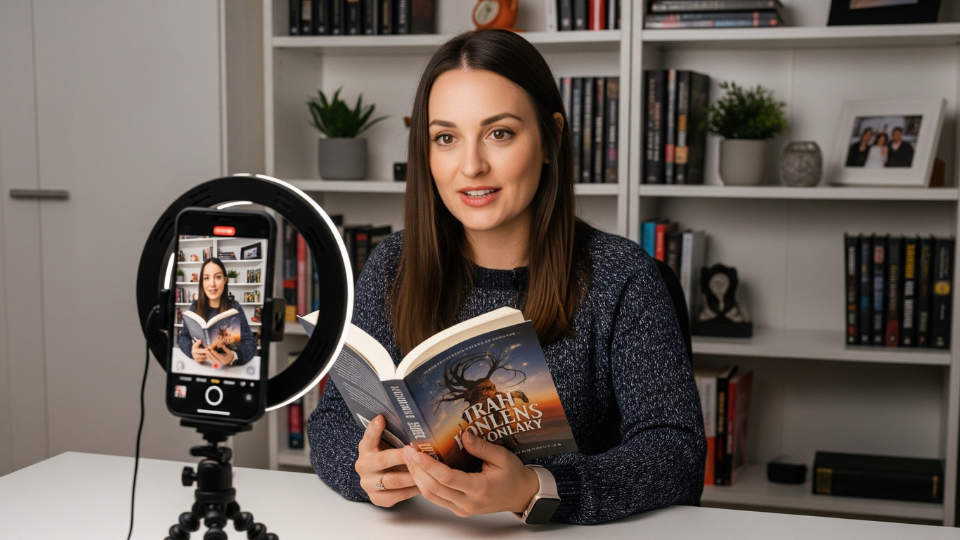
Readers don’t just want to read your book. Many want to hear your voice, see your process, and feel your energy. That’s where video steps in—not as a replacement for the written word, but as a way to bring your story off the page.
You don’t need to be a content creator or have professional gear. You just need to understand what kind of video helps you connect—and why algorithms keep rewarding authors who try.
Algorithms reward video, not just followers
Video is favored across nearly every platform. TikTok is built on it. Instagram pushes Reels more than static posts. Even YouTube Shorts and Facebook Stories are seeing higher engagement than traditional updates.
This doesn’t mean you have to go viral. It just means you’re more likely to show up on people’s feeds if you use video—even short, simple clips shot on your phone.
The benefit? Better discoverability. Your content reaches people who aren’t already following you, which is crucial when promoting a new release.
You don’t need to perform to make an impact
The biggest barrier for most authors is the fear of being on camera. You don’t have to dance, do comedy, or share every detail of your life to make a powerful video.
Here are a few low-effort, high-impact ideas:
- A timelapse of your writing or editing session with music
- A short voiceover reading your book’s opening line or favorite quote
- A silent flip-through of your printed proof with ambient music
- A “caption-only” video of your writing process with text overlays
You can also use stock footage or B-roll paired with voiceover or subtitles. The point isn’t to entertain. It’s to connect.
Prep your talking points so the camera doesn’t scare you
If you’re comfortable speaking to your audience, make it easier on yourself by planning ahead. You don’t need a full script—but a simple outline of what you want to say will help you feel more confident.
Structure your short videos like this:
- Hook (3 seconds): Ask a question or say something unexpected.
“What if your worst memory was the key to unlocking someone else’s life?” - Message (15–45 seconds): Share a scene, a behind-the-scenes insight, or what inspired the chapter.
- CTA (optional): Gently invite them to read, comment, or follow.
“That scene broke me—if you’ve ever felt this way, chapter 7 is for you.”
Short-form video is about intimacy, not polish. Talk to your reader like you’d talk to a friend over coffee. That’s what sticks.
Make Your Followers Feel Like Insiders
Readers love to feel like they’re part of something. When you treat them like they’re inside the circle—not just watching from the outside—they start rooting for you. That’s the difference between a follower and a fan.
Create a launch build-up that feels like a shared experience
Most authors go silent, then suddenly drop a “My book is out!” post and wonder why it flops. A better approach? Start early and take readers along for the ride.
Here’s a basic timeline you can adapt:
- 2 months out
Share early drafts, behind-the-scenes notes, mood boards, or playlists that inspired the book. - 1 month out
Reveal the cover. Ask your audience to vote between options or help choose a teaser quote. - 2 weeks out
Share sneak peeks, pre-order links, early reader reactions, and personal reflections on what the book means to you. - Launch week
Post daily. Use carousels, Reels, videos, and thank-you notes. Go live. Celebrate the win, and make it feel like their win too. - Post-launch
Keep sharing reviews, quotes, and milestones. Let the momentum build instead of going quiet.
This way, readers feel like they’ve helped build something—not just watched it happen.
Use polls, stories, and replies to create two-way engagement
One-sided posting feels cold. When you invite feedback—even small moments of interaction—readers are more likely to stay connected.
Ways to involve your followers:
- Use Instagram Stories or Twitter polls to ask about character names, favorite tropes, or reader preferences.
- Reply to comments with more than just “thanks.” Ask follow-up questions or show appreciation in a personal way.
- Invite them into the process: “Thinking about writing a bonus scene—should it be from [Character A] or [Character B]’s POV?”
The more they talk back, the more the algorithm helps your content show up. But more importantly, you’re making it personal.
Turn your core followers into your launch team
Not everyone in your audience will buy your book—but a handful will go the extra mile to support you, if you ask them the right way.
Here’s how to build that launch crew:
- Identify your core audience. These are the people who comment often, reply to DMs, or have read your earlier work.
- Reach out personally. Invite them to join your ARC list, private reader group, or insider list.
- Offer something meaningful. It doesn’t have to be fancy—early access to chapters, handwritten notes, or a private Q&A goes a long way.
Then, give them the tools to help spread the word: review prompts, quote graphics, sample captions. When readers feel like they belong, they’re more likely to share your story like it’s their own.
Consistency Without Burnout
You don’t need to post daily to build a loyal audience. You just need a rhythm that works for your energy, your schedule, and your readers. The key isn’t quantity—it’s consistency with purpose. This section is all about building a system that helps you show up online without letting social media consume your writing time or peace of mind.
Use a content calendar that supports your writing life
Trying to post on the fly every day is a fast track to frustration. A simple content calendar can take the guesswork out of what to post and help you stay consistent, even when life gets busy.
Here’s a 3-day-per-week starter plan that works for most authors:
- Day 1: Story or Process
Share something behind-the-scenes—a writing habit, draft page, or emotional moment in your process. - Day 2: Quote or Insight
Post a line from your book, a reader review, or a short insight on your genre or writing journey. - Day 3: Engagement or Promotion
Ask your readers a question, share a giveaway, or point them toward your pre-order link.
This rotation keeps your content varied and purposeful. You can always add more later, but this baseline gives your followers enough touchpoints to stay engaged.
Batch content to protect your creative time
Posting consistently doesn’t mean creating content from scratch every day. Batching—creating multiple posts in one sitting—saves time and protects your writing flow.
A typical batching workflow:
- Pick one morning every week or two to prep posts.
- Use templates for quote graphics or promo posts in Canva.
- Write captions in a Google Doc before uploading them to your scheduler.
That one focused session can often cover 1–2 weeks of content. It frees up the rest of your time to focus on your manuscript, your readers, or a walk outside that has nothing to do with books.
Use tools that make content management easier
You don’t need to juggle everything manually. There are reliable tools that make planning, creating, and publishing smoother—without overwhelming you with analytics or marketing jargon.
Here are a few favorites for authors:
- Later (later.com): Great for scheduling Instagram, TikTok, Pinterest, and Facebook. Has a visual calendar and drag-and-drop interface.
- Buffer (buffer.com): Clean and easy to use for Facebook, Instagram, LinkedIn, and Twitter.
- Metricool (metricool.com): All-in-one dashboard for planning, scheduling, and tracking performance. Supports multiple platforms and includes link-in-bio tools.
- Notion or Trello: Ideal for mapping out post ideas, organizing your launch calendar, and tracking content themes.
For video:
- Descript: A simple tool for editing short talking-head or voiceover videos without needing editing skills.
- CapCut: Great for TikTok and Instagram Reels. Includes auto captions, trending effects, and templates.
You don’t need to master every feature. Just use these tools to make your life easier—not busier.
What Most Authors Get Wrong About Social Media
Many authors show up online with the best intentions—then wonder why nothing’s landing. The problem isn’t the platform. It’s how it’s being used. Social media can work for authors, but only if you understand the common traps that sabotage your momentum.
This section covers the most frequent mistakes—and how to fix them without burning down your whole strategy.
Posting links without any context or connection
Dropping a raw Amazon link into your caption and calling it a day rarely leads to clicks. Readers scroll past because there’s no reason to stop, no reason to care.
What to do instead:
Give context. Share a quote from the book. Talk about what inspired the scene. Explain how readers have responded. Make the post about something, not just a link.
Example:
“I wrote this chapter when I was grieving my grandmother—it’s still the hardest one to read aloud. Here’s a line that stuck with me. Link’s in bio if you want to read more.”
That kind of setup gets noticed—and remembered.
Ignoring DMs, comments, and replies
Every comment is an open door. Ignoring them sends a clear message: you’re not listening. Even worse, it stalls your growth. Platforms reward posts with interaction—and conversation boosts reach.
What to do instead:
Make it a habit to check your notifications once a day or a few times per week. Reply with a full sentence or a thoughtful emoji. Let your audience know they matter.
When someone shares your post to their Story or tags a friend, take a second to say thanks. That small moment builds a connection you can’t buy with ads.
Going all-in only during launch week
Too many authors treat social media like a light switch. It’s off for months, then suddenly on full blast during launch week. This creates a jarring experience for followers—and it doesn’t build the kind of trust that leads to book sales.
What to do instead:
Think long-term. Social media works when it becomes part of your author rhythm. A few posts a week, consistently over months, will do more than one frantic week of nonstop promotion.
Let readers walk with you from idea to draft to launch. That journey is what gets them invested.
Forgetting to tell readers what to do next
You’ve written a beautiful post. It’s emotional, thoughtful, and powerful—but then it ends without a nudge. If your readers don’t know what to do next, most won’t take action.
What to do instead:
Always include a soft CTA (call to action). It doesn’t have to be pushy—just clear.
Some natural examples:
- “Want to read the rest? Link’s in my bio.”
- “Tell me your favorite book that made you cry.”
- “If this resonated with you, Chapter 10 is for you.”
A post without direction feels incomplete. A gentle nudge can turn interest into action.
How to Turn Followers Into Book Buyers

Having an audience is great, but an audience that actually buys your book? That’s the real goal. And while social media isn’t a storefront, it is a funnel—guiding readers from passive scrollers to people who take action.
This section unpacks how to build trust, earn interest, and guide your followers toward the buy button—without sounding pushy.
Give people more than one reason to care
People don’t buy books just because they exist. They buy because something about the story, the voice, or you resonates. So before you think about selling, think about why someone might feel pulled toward your book in the first place.
Make sure you’re:
- Sharing what your book means to you, not just what it’s about
- Posting quotes or scenes that spark emotion or curiosity
- Framing your book as an experience, not just a product
When someone feels connected, the sale becomes an extension of the relationship—not a transaction.
Make sure your audience sees your book at least seven times
There’s a marketing principle called the Rule of 7: people typically need to encounter a message seven times before they take action. That doesn’t mean repeating the same post—it means showing up in a variety of ways that keep your book top-of-mind.
Here’s how to do it without being repetitive:
- Share different quotes or lines across multiple posts
- Use Stories, Reels, and feed posts to tell different angles of your book journey
- Reshare reader reviews or testimonials
- Mention your book casually in captions when talking about related themes
Repetition doesn’t have to feel like spam. When done creatively, it feels like presence.
Use clear, soft CTAs that guide readers naturally
You don’t need a hard sell. You just need to ask. A clear CTA (call to action) helps readers know what to do next—and it often makes the difference between “that’s cool” and “I’ll check it out.”
Keep it simple and human:
- “Want more like this? The book’s waiting for you.”
- “If this line gave you chills, there’s more where that came from.”
- “This scene wrecked me. If you’ve ever felt like this, you’ll find yourself in Chapter 9.”
And always make it easy to act. Keep your link accessible (in bio, in Stories, or in pinned posts), and tell readers exactly where to go.
Let readers do some of the talking
Social proof matters. When potential readers see that other people are engaging with your book—through reviews, reactions, or reposts—it builds credibility and curiosity.
Smart ways to use it:
- Screenshot early reviews (with permission) and post them
- Repost tagged Stories or reader photos
- Share kind comments as carousel slides or in Stories with a thank-you
Even one reader saying “I couldn’t put this down” carries more weight than a hundred self-written promo lines. Let their words speak for your work.
Real Authors Who Did It Right
Sometimes, the best way to learn what works is to watch someone else do it well. Not every author has a big budget or a marketing team—but many have figured out how to build momentum through social media by leaning into their strengths and staying authentic.
This section highlights three real-world examples of authors who grew their audiences and boosted book sales by using platforms intentionally.
A fiction author who made Reels feel like mini stories
Platform: Instagram
Genre: Contemporary romance
What worked:
This author started posting short Instagram Reels that mirrored the tone of her book—funny, flirty, and emotionally charged. She used trending audio clips, paired them with quotes from her characters, and captioned them with moments readers would recognize after reading the book.
Her feed became an extension of her storytelling. Followers who hadn’t heard of her book before were hooked by the voice before the story. And by the time she launched her next title, her audience was ready and waiting.
Key takeaway:
Use the tools of the platform to tell the kind of story you’re already good at. If you write fiction, Reels can be scenes in motion—not just ads.
A nonfiction author who turned LinkedIn into a book tour
Platform: LinkedIn
Genre: Personal development / leadership
What worked:
Instead of promoting the book outright, this author broke it down into digestible insights and posted them regularly as mini-essays. Each post focused on a single lesson or question from the book—inviting conversation rather than pitching.
He responded to comments thoughtfully and kept his link in a pinned comment or bio. Over time, those who followed for the insights ended up becoming book buyers because of the value they already received.
Key takeaway:
Teach first, sell second. If your content gives people something useful now, they’ll want to know what else you have to offer.
A YA author who built a BookTok fandom with zero polish
Platform: TikTok
Genre: Young adult fantasy
What worked:
This author didn’t have professional video equipment, a ring light, or editing skills. What she did have was energy and love for her characters. She posted chaotic, funny videos talking about her world-building, character trauma, and tropes her book included (enemies-to-lovers, morally gray love interests, etc.).
She didn’t worry about being “on brand.” She worried about being real—and her audience grew fast. Her ARC requests tripled, and her book sold out its first print run in preorders.
Key takeaway:
On TikTok, passion > polish. Readers respond to raw enthusiasm, especially when it’s specific to the story world.
How Trelexa Can Help You Promote Your Book on Social Media
You don’t need to go viral to make your book visible. You just need the right readers seeing the right story at the right time. That’s what we help with at Trelexa. We work alongside authors to turn your message into content that resonates—through done-with-you strategy, behind-the-scenes execution, and tailored social media campaigns that feel natural, not forced.
If you’re ready to stop guessing and start growing, we’re here to walk with you.
Final Thoughts
Social media can feel noisy, overwhelming, and at times, thankless. But for authors, it’s still one of the few places where your voice, your message, and your book can reach people directly—no middlemen, no gatekeepers.
You don’t have to do everything. You just have to start showing up with intention. Share the parts of your journey that feel real. Invite readers into your process. And trust that every post, every comment, every reader who pauses to listen—is part of something bigger than metrics.
The stories that stick are the ones that come from a place of truth. Let yours be one of them.